This interview was held in Rome on 6.2.26 by ‘German Foreign Policy’.
https://www.german-foreign-policy.com/fr/news/detail/10292
ROME (exclusive report) – This Friday, workers from more than 20 of the largest ports in the Mediterranean are organizing a day of action to protest against the EU’s militarization policy and against the use of ports for the supply of weapons in the war in Ukraine and Israel. They oppose “the transformation of the Mediterranean into a crossroads for the war economy,” explains Cinzia Della Porta in an interview with german-foreign-policy.com.
Della Porta is a member of the executive committee of the Italian union Unione Sindacale di Base (USB),which participates in the organization of the day of action. The USB requires that the ports of the Mediterranean be “places of peace”. Della Porta points out that workers are always among the first to pay “the price of war” in the form of wage reductions for example, or restrictions on union rights, which are “direct consequences of the war economy”. In addition, the dockers who have to load the weapons become involuntary accomplices of wars which they reject. Della Porta pleads for “resistance to war to be associated with social struggles for wages, public services and workers’ rights”.
This Friday, demonstrations are planned in particular by the USB and the unions Enedep (Greece), Liman-İş(Turkey) and ODT (Morocco). Actions and strikes are planned from Tangier to Genoa, Palermo and Trieste to Piraeus, Antalya and Mersin, as well as on the Atlantic coast, for example in Bilbao.
The demonstrations include the ports used for arms deliveries, but used also for wage and pension reductions for the benefit of financing war, as well as European Union (EU) armament plans, including the militarization of ports and other strategic infrastructure in Europe. According to the USB, rallies are also planned in Hamburg and Bremen.
german-foreign-policy.com: On Friday, a day of joint action will take place in more than 20 Mediterranean ports. What exactly is it?
Cinzia Della Porta: Friday’s coordinated action aims to combat the increasing militarization of ports and logistics, the use of civilian infrastructure for military purposes and the transforming of the Mediterranean into a crossroads for the war economy. Our message is clear: ports must not be used to load, unload or even simply transport weapons intended for war, massacres or occupation.
Workers from several Mediterranean countries, including Italy, Spain, France, Greece and other countries in Southern Europe and North Africa, are participating in this action. This reflects the common awareness of port and logistics workers that war is not an abstract geopolitical issue, but something that directly affects their workplace. This strike is part of a broader international mobilization against war and the war economy.
german-foreign-policy.com: Workers in Italy and other Mediterranean countries have already protested against arms deliveries…
Cinzia Della Porta: Yes, several concrete actions have been taken. In Italy, port and airport workers refused to load or tranship military goods such as weapons and explosives. In some cases, workers blocked port operations or stopped work when they discovered military transport.
Thus, workers at Italian ports and airports have jointly stopped processing arms deliveries to Israel or Ukraine and have forced companies and authorities to divert or delay transport. Similar actions took place in other Mediterranean countries, where workers drew attention to the military nature of these deliveries through strikes, work stoppages and public demonstrations.
For those who, in Germany or other countries, have not been informed by the mainstream media, here is what we did in Italy:
There was the case of the “death ships”, the ships of the shipping companies ZIM and Bahri. In Genoa, USB workers monitored the cargo using “worker intelligence” and compared route and content data. When a ship of the Israeli shipping company ZIM docked, the dockers went on strike or blocked the doors with pickets.
There was then a case at the airport of Pisa with weapons destined for Ukraine. USB workers refused to touch a plane at the civil airport that was loaded with boxes filled with weapons and ammunition, disguised as “humanitarian aid”. The workers saw the containers, documented that they contained weapons and not food or medicine, and called out this situation.
Finally, there was also administrative sabotage. In some cases, the refusal to provide technical services – for example by tugboats or moorings – forced ships carrying arms cargoes to stay in port for several days, resulting in huge economic losses for businesses and sending a political signal to governments.
These actions were not purely symbolic. They directly disrupted the logistics of war and unmasked what governments are trying to hide from the public.
german-foreign-policy.com: Why should workers fight against militarisation and war?
Cinzia Della Porta: Workers are the first to pay the price of war. Militarization leads to reductions in wages, social benefits, health care, education and public services, while huge resources are diverted to weapons and military spending. Inflation, precarious employment and deteriorating working conditions are direct consequences of the war economy.
At the same time, workers are often forced, by their work, to become involuntary accomplices of war. Opposing militarization is therefore both material and ethical. Workers have a unique power: by stopping production and logistics, they can disrupt the war machine at its root.
War is not an isolated event, but the only way for the capitalist system to survive a serious crisis. Take the example of the redistribution of wealth: the Italian government increases military spending to 2% of gross domestic product, or more than 100 million euros per day. This money is taken directly from collective agreements, the national health system and education. Militarization is in reality an economic manoeuvre of the ruling class against the poor.
Militarization also leads to authoritarianism and oppression. The war economy requires “discipline”. This means stricter laws on strikes, precarious working conditions and the repression of union opposition. As a class union, the USB combines the struggle for workers’ rights with the fight against war. Since February 2022, our slogan is: “Down with the weapons, raise the wages! “
german-foreign-policy.com: The USB also participated in protests against the genocide in Gaza.
Cinzia Della Porta: Support for Palestine has always been part of our DNA. Since the beginning of the genocide, we have launched initiatives and strikes in favour of Palestine and actively participated in all the national demonstrations that have taken place in Italy on this subject. Our workers have actively blocked ships in ports, but have also refused to participate in research projects conducted in collaboration with Israel in universities and public research institutes.
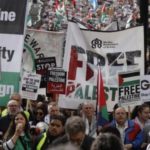
What happened during the USB strikes on September 22 and October 3, 2025 was incredible. In a hundred Italian cities, hundreds of thousands of people joined the strikes and invaded the streets and squares. We announced that we would “block everything”, and this is what we did. Strikes and demonstrations were organized to end the genocide and the complicity of the Italian government with Israel. The strike of 28 November linked support for Palestine & ending the genocide, with the fight against the war economy and the internal war on workers and the population.
We consider this strike a political success, because it broke the silence on the complicity of the institutions and clearly linked the struggle of the Palestinians to the resistance against the war economy and against Italy’s role as a supplier of arms. This strike showed that part of the working class refuses to accept genocide, occupation and war as “normal”.
german-foreign-policy.com: The repression is intensifying; several firefighters have been sanctioned for participating in the demonstrations.
Cinzia Della Porta: Yes, several firefighters who had publicly expressed their solidarity with the Palestinian people or participated in demonstrations were subject to disciplinary measures, investigations and sanctions. In some cases, they were accused of violating the “neutrality” of public institutions, simply because they had spoken out politically against genocide and war.
Repressive measures of this type are intended to intimidate workers and stifle divergent opinions. These measures are part of a broader authoritarian trend that is to treat as a problem those who oppose war and militarization, rather than those who support or facilitate war crimes.
Our coming Friday strike is not an isolated event. It will continue our struggle as a class union linking resistance to war with the social struggles for wages, public services and workers’ rights.
We will continue to promote international coordination between workers, particularly in strategic sectors such as ports, logistics, transportation and public services. The USB will continue to fight against the war economy, against arms deliveries, against Italy’s participation in NATO wars, against arms deliveries to Ukraine, in solidarity with the Palestinian people against the genocide in Gaza. Our fight against war is inseparable from the struggle for social justice and the dignity of workers. We will continue our fight in Italy and internationally within the World Federation of Trade Unions (FMS).
We are aware that the situation is difficult and that the Italian government has opted for repression. For example, the Italian government proposes a new security decree that punishes divergent opinions and restricts the room of demonstrations to manoeuvre.
In this context of deteriorating economic conditions, growing international instability and the spread of insecurity in widening segments of the population, the Italian government has therefore decided to toughen repression. We have all the more the duty to continue our fight.
End.
This interview was published by the site Alerte OTAN, 9 Feb 2026.
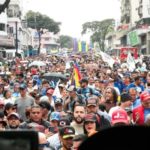
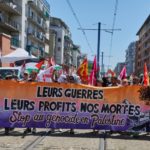
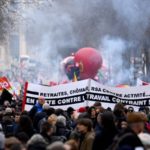
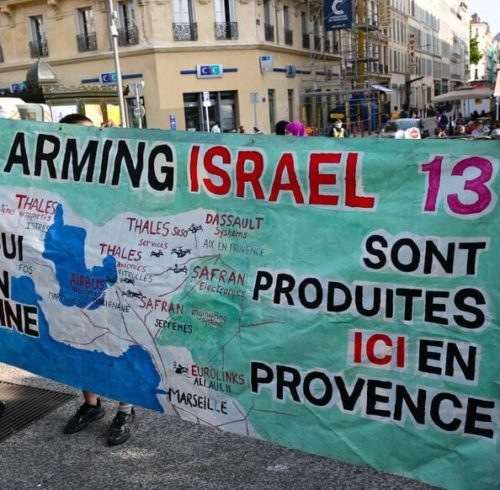
Feature Photo: A striking dockers’ banner in Marseilles, protests 13 arms producers in Provence.
Share this story!
&.&.&.&.
Posadiststoday’s notes drawn from trade union groups’ reports and from Wikipedia:
In November and December 2025, a series of general strikes spread throughout Europe, in Italy, Belgium and Portugal in particular.
In 2025, the Italian grassroots trade union Unione Sindicale di Base (USB) initiated and participated in massive, nationwide mobilisations and general strikes in support of Gaza, demanding an end to the conflict and halting arms shipments to Israel. These actions were characterized by significant worker participation, blocking infrastructure and protesting government policy.
Key 2025 USB Mobilisations for Gaza:
. 22 September 2025 – Nationwide General Strike in Italy: USB, alongside other grassroots unions (CUB, SGB, ADL, USI), organized a 24-hour general strike, termed a “flood” of action, demanding an end to the genocide in Gaza.
Impact: The strike involved over a million people, with 90% of public transport and 50% of railways shut down, alongside disruptions to ports, factories, and schools.
. “Blocchiamo tutto” (We Block Everything): The action was aimed at stopping the “war economy” and supporting the Global Sumud Flotilla.
. 3 October 2025 – Second National General Strike: Following the Israeli boarding of the Global Sumud Flotilla, USB and CGIL called a second general strike, which caused further, widespread transport disruption.
. “100 Piazze per Gaza”(100 Encampments, protests and sit-ins in Public Squares for Gaza): USB launched this permanent mobilization with Palestinian organizations to maintain pressure through ongoing, local protests.
. Port Blockades (Genoa & Livorno): USB dockworkers (CALP) actively blocked arms shipments to Israel, specifically targeting the vessel “Zim New Zealand” in Genoa and “Virginia” in Livorno.
. 14 November 2025 – “No Meloni Day”: USB supported and participated in widespread anti-government, and pro-Palestinian protests across Italy.
. 28 November 2025 – Additional Strike: USB and CUB declared another general strike for late November in support of Palestine.
Key Characteristics of the 2025 Mobilisations:
Origins: The actions stemmed from a call by Genoa dockworkers (CALP) to halt the European economy in response to the situation in Gaza.
Solidarity with Flotilla: The actions aimed to protect the Global Sumud Flotilla, which was bringing aid to Gaza.
International Coordination: USB hosted international dockworker delegations (from France, Greece, etc.) to coordinate a joint strategy to block arms shipments.
Opposition to Government: The actions heavily criticized the Italian government’s “inertia” and refusal to impose sanctions on Israel.
These actions were noted as the largest protests in Italy in years, showing a strong, coordinated effort by labour unions to leverage economic power for humanitarian and political cause