The ‘danger’ here is a fabrication that places Russia central stage, labelled extreme threat’ and set to invade Europe before 2030 (&). This is the view that the Chief of the Defence Staff, General Thierry Burkhard, had developed two days earlier during a press conference, presumably to lend more credibility to this speech of the President of the Republic.
It is on the basis of this reasoning therefore, that the country should be accelerating its rearmament, its arms sales, and the militarisation of its industrial-economic sectors – to proceed with finding the extra funds necessary to “let our armed forces defend our freedom”.
To the detriment of the social needs and the environmental emergency, the defence budget will have to be increased, never mind the enormous public debt which reached €3,345 trillion (nearly 4 trillion) at the end of the first quarter of 2025.
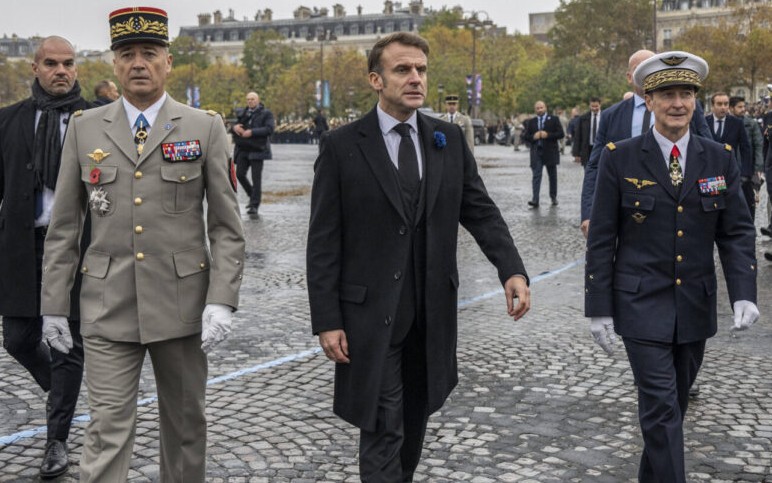
The ‘defence of Ukraine’, and the forced march towards war
Ukraine must be defended at all costs against Russia, since it has become a permanent threat on the borders of Europe. In the published decisions of the French government’ you read: “Never since 1945 has liberty been so threatened … the liberty of the peoples is being flouted by imperialisms and powers of annexation … freedom is being trampled when the rules of war are erased … the freedom of our Europe was threatened at the very moment when war was brought to our soil by the [Russian] invasion of Ukraine …”
Here, the notion of liberty – the first of the three values of the French Republic enshrined in the Constitution – is utilised by the government for the sole objective of confrontation and war. Since contrary to the stated objective, the notions of equality and fraternity have become inexistent.
This view of ‘the defence of liberties’ is a collective manipulation. But you find it in the discourse of all the capitalist powers, all in crisis, all looking for scapegoats to criminalise their political opponents. They invoke a so-called “clash of civilizations” allegedly acting against democracy, what they call democracy, to justify the measures they take, measures that lead to their violent clashes with the population. Capitalism introduces totalitarian and fascist-like policies as the only way it has to keep its grip on power.
Defence has been the priority of the President of the Republic since his election in 2017. After weeks of debate in the National Assembly and Senate, the 2024-2030 military budget was finally adopted, to the tune of €413.3 billion. The amount going to the armed forces doubled since 2017. It is now set to rise incrementally in the next two years with an additional investment of €10 billion: €3.5 billion for 2026 and €6.5 billion for 2027. Macron calls for a “national effort on behalf of all the French“. Add to this the return to the National Military Service soon. A glimpse of this was already on offer during the SNU days (the Universal National Service); this is a civilian service offered to young people aged 15 to 17 “who wish to make a rich collective experience, useful to others, forging strong bonds, discovering a talent for civic engagement” – in government parlance.
Macron is not the only one to accelerate rearmament and announce wartime economic plans. With its “ReArmEurope” program, the European Commission allocates €800 billion to the national industries of the 27 EU member states. This priority public investment will compensate for the present shortcomings in the weapons production capacity of the European countries. And it will give them a measure of independence from the world’s leading arms supplier, the United States.
This investment must however cater also for the military support of Ukraine; as well as for the possible conflicts and threats, the new technologies, cyberspace and artificial intelligence. This leads to an explosion in weapons’ purchase plus military hardware more and more sophisticated.
It is probable that the European Union will not be able to cover the costs of this rearmament. EU military spending on Ukraine went up from €204 billion in 2022 to €326 billion in 2024. But in the current economic climate, the capitalist countries see their deficits constantly on the rise. The EU had to modify its own rules to facilitate its increased spending and is now appealing to private funding. This is how a ‘defence fund’ has been set up for individuals, drawn from people’s savings, life insurance policies and long-term investments, among other things, and without always consulting the policyholders.
NATO is the instrument for the war
In his address to the Armed Forces, Emmanuel Macron announced his wish to “build the true European pillar of NATO”. The Hague Nato Summit of June 24 and 25 decided to raise the contribution of its 32 member-countries from 3.5% to 5% of GDP by 2035. For France, this increase means finding an additional €8 billion, while the need to make significant further savings is also being hammered home.
With their support for Nato, the European countries of the Atlantic Alliance show their disposition to keep pushing ahead at all costs with war preparations against Russia. And not only Russia, but the other countries on NATO’s blacklist too: China, Iran, North Korea. The way NATO stands at the centre of Europe’s collective defence confirms that it has no aim of achieving peace. It cannot accept Ukraine’s defeat in the conflict with Russia. Nato’s insistence on having Ukraine helped to protect Europe from Russia makes it the engine of endless escalation to military confrontation.
It was on the sidelines of the NATO summit that the Defense Industries Forum was held, with representatives from Germany, Belgium, Canada, Denmark, Greece, Italy, Norway, the Netherlands, Poland, the United Kingdom, Sweden, and Turkey. Zelensky was invited and called for increased funding for Ukraine to develop its own capacity to produce, among other things, 8 million drones per year. According to the NATO’s website, the Forum’s objective is to seek such concrete solutions jointly, strengthen defence industries for quicker and larger scale production, and still keep enough stocks of raw materials essential for production and to protect the population!!!
But the European Union is not capable of conducting even a common defence policy. Each member state has its own political and economic interests. Each contends with the race for profits, international markets competition, the new trade war launched by Donald Trump and his tariffs. They have no coherent policies. You see it in their incapacity to make the decision to condemn Israel in the Middle East for its genocide of the Palestinians and its aggressions in Lebanon, Syria and Iran.
The war in Ukraine is accelerating the contradictions and political divergences in Europe, not only within right-wing sectors but also among parties and movements claiming to be on the left. It is also accelerating the radicalization of an increasingly large segment of the population under the constant blows of austerity policies and institutional violence.
The rise of far-right movements and the fascisation of society are necessary to capitalism – to the financial sectors in particular. For them to keep the power, they resort to all the means to repress the oppositions that defend the migrants, the environment, the hard-won social rights.
In all the debates in the European countries, NATO and the war preparations must figure centrally. Nato’s eastward expansion is at the core of the war in Ukraine, and Ukraine joining NATO would open the door wide to World War III. Gripped by a collective hysteria, the big capitalist countries paint Russia as a country drunk on conquest, to supposedly rebuild its empire. This takes us straight to confrontation.
It is urgent to oppose the militaristic plans of France, the EU, and NATO. The left-wing parties and trade unions must adopt a working strategy of rupture with the system: a clear campaign of withdrawal from NATO, and a plan of transformation to meet the needs of society, health, the environment.
The austerity budget 2026
Who will be paying for this rearmament effort and Nato reinforcement? The same as always: the poorest, the working class, the unemployed, the public services. But this effort is also such a huge step backward in comparison with the policies wanted to deal with climate change and its consequences; and the need to prevent the fires and floods that keep recurring over the years.
It was the day after the Bastille Day Parade that the Prime Minister presented his new austerity plan for 2026. A planned saving of €44 billion will go to repay the national debt without touching the wealthiest individuals! This explains the unprecedented level of social dismantling, as in: a freeze on public spending, a reduction of 3,000 civil service jobs (except those in defence, of course). The cuts in the regional authorities’ budgets will be felt at local levels with more austerity, the elimination of two public holidays without compensation, the new reform of the unemployment insurance, more attacks on the social benefits and the retirement pensions, etc.
According to 2023 figures published this July by the National Institute of Statistics and Economic Studies (INSEE), France witnesses its highest poverty levels in thirty years: nearly 10 million people live below the poverty line, affecting one in six people – and this figure has increased by 650,000 in just one year. Inequality is constantly rising, with gaps increasingly significant between the wealthiest and the poorest. The working poor represent 8.3% of the workforce, and a growing number of employees are forced to rely on charities to feed themselves.
The unemployment rate is 7.4%. Instead of decreasing, it started to rise again in 2025 despite efforts to conceal the true figures due to new regulations that have altered the conditions for receiving benefits, as well as the surge in layoffs and company closures in recent months: 400 redundancy plans in one year. The French government has largely contributed to the deterioration of the country’s economy and the dismantling of society. A Senate inquiry commission sought to shed light on the public subsidies handed over to large corporations in 2023. Its report was published on 8 July (2025) after months of travails and 70 hearings with ministries, government departments, public institutions, unions and economists. It deplores the complexity of a system comprising more than 2,200 different mechanisms. A system that makes it impossible to gain a clear and precise overview of amounts disbursed, through lacks in transparency, monitoring and evaluation. State subsidies to the biggest companies was estimated at, at least €211 billion; “crazy amounts of money” that never prevented de-localisations, layoffs and bulging shareholders’ pockets. A scandal. See how public money props up the capitalist system!
This amount of public money could have funded healthcare, education, pensions and public services in such a great peril. Public hospitals and emergency services deteriorate daily. Staff are on the verge of exhaustion due to bed closures and the unbearable working conditions. The latter are caused by the lack of funding. Decent wages are lacking. The operational methods are based on efficiency and securitisation rather than on the quality of care.
In early August, staff at the Hôtel-Dieu hospital protested against a real estate project to transform 20,000 square meters of hospital space into a shopping centre. A private developer is to build restaurants there, shops and a museum dedicated to Notre-Dame Cathedral, reducing patient care space by 50%. This systematic dismantling of the public healthcare system is happening all over France!
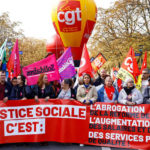
Below, demonstration in Paris against the Law Duplomb, 8.7.2025.
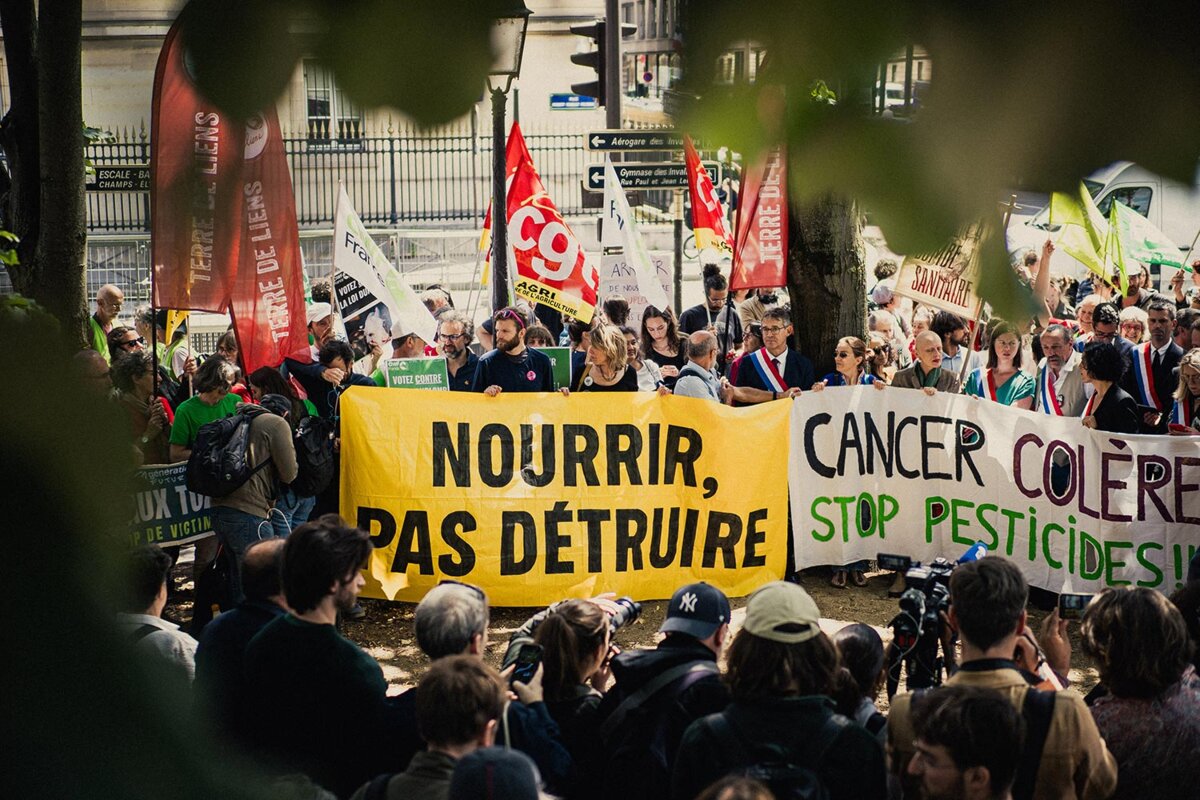
Over a number of years, 1,200 studies have been published worldwide on the risks of pesticides. These studies show a convergence of conclusions : pesticides are at the heart of the resurgence of cancers. In France, doctors report 400,000 new cases of cancer per year, including an increasing number of children. They demonstrate that the increases are not due to aging or genetics. Since 2017, the French Agency for Food, Environmental and Occupational Health & Safety (ANSES) published three opinion-papers on neonicotinoids and demonstrated their danger for human health
Petitioned by left-wing members of parliament, the Constitutional Council (legal body that forces all new laws to comply with the constitution) issued a ruling on pesticides on 7 August. The Article 1 of the Charter for the Environment, stipulates that “everyone has the right to live in a balanced and healthy environment“. The Council struck down as ‘unconstitutional’ the portion of the law that reintroduces the pesticide; and it expressed reservations regarding the construction of mega-reservoirs. This was an important, albeit partial, victory for the environment and human health, because Macron quickly promulgated the amended law on August 12.
Mobilizations are being prepared.
Anger is a powerful driving force, and a mobilization is underway in response to François Bayrou’s austerity plan. Although wearing no political label, a movement has formed under a “Block Everything!” banner. It called for demonstrations on September 10 and intends to make of that day the start of a total and unlimited shutdown. Not unlike the Yellow Vests of 2018, it circulates on social media, generating discussions in the left-wing parties and the trade unions.
The Intersyndicale (inter-union) group will meet on September 1st to discuss next steps, but some CGT federations and departmental sections – in the chemical and retail sectors particularly – have already decided to join the movement on September 10th. The Union Federation ‘mines-energy’ is calling for a strike to start on September 2nd. The Union Force Ouvrière (one of the five largest Confederations) has filed a strike notice from September 1st to November 30th.
In an opinion piece published on August 11th, prominent figures, members of political organizations and numerous associations have now called for people to join the September 10th action, to get it larger and prolonged.
In today’s situation, the social movements have some power of determination in the fight to defeat the PM’s austerity measures, in defence of the natural environment, health and the public services. But beyond this even, one must reject the military budget and the arms race. One must insist on the other measures aimed at satisfying the needs of the population.
Whoever the organizers of “Block everything” may be, it seems important to organize and participate in their 10 September mobilization. It can only benefit unity between all the left-wing parties, especially in light of the divisions that need overcoming about the municipal elections of March 2026.
Les Posadistes – August 15, 2025
(&) https://european-security.com/en/russia-an-existential-threat-to-europe/
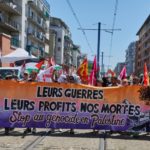
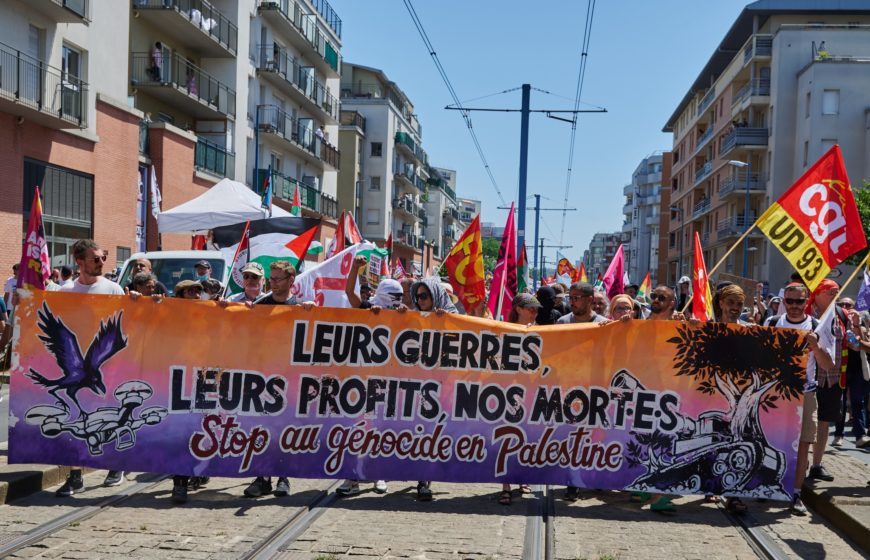
Feature image: Demonstration Paris, 21 June 2025, in opposition to the Arms Show at Paris Le Bourget in Seine-Saint-Denis. This particular Citizens mobilisation helped to keep the Israeli arms stands out of the show.
[1] The Duplomb Law was successfully spearheaded by Senator Laurent Duplomb in August 2025. It sets out the aim of reducing bureaucracy in agriculture by promoting industrial farming and water-storage projects. The law’s opponents denounce these measures intended to rationalise profit-making for the few. They are particularly incensed by the legalisation of the neonicotinoid pesticide acetamiprid, banned up to now.