The Third World War which the capitalist system is desperately preparing to launch against humanity, is at the heart of the concerns of all progressive sectors of global society. To confront this very critical situation, the need is urgent to develop the tools that lead not to “the end of history”, but to the end of this capitalist regime.
To achieve this, one must assess fundamentally the function played by the Soviet Union since 1917, its triumph as the first Workers State and the true extent of its dislocation in 1992. About the latter, the Posadist Fourth International speaks of a partial disintegration. For one must also identify and observe what aspects belonging to the Soviet Workers State survived after 1992, and continue to live on in the Russia of today.
Our International Scientific Cultural and Political Editions (ISCPE) published this book in its Spanish original in October 2025. As J. Posadas died in 1981, the book’s title is from the Editorial Board. The ISCPE have already published several books by J. Posadas on this question. These include “Workers State and Socialist Society” (1968) and “The Soviet Union: Historic Experience and Essential Program for the Construction of Socialism” (texts from 1968 to 1981).
We are publishing this book separately. This is only its prologue. The book itself contains three chapters. These focus on the “Partial regeneration” in the USSR and the world Communist movement, as J Posadas saw that process emerging during and after World War II. That process stemmed from the way the Soviet masses fought, and the way they defeated the Nazis at Stalingrad. More generally, it stemmed from their unconditional defence of the Soviet Workers State. With the subsequent spread of revolutions in Eastern Europe, J. Posadas saw that, although still in the orbit of the Soviet apparatus, conditions were being created for a regeneration in the Soviet Union. A regeneration that did not exclude Political Revolution as a way to eliminate the bureaucracy. Following WW2, the new relations of power in the world became markedly favourable to revolution. To justify its role as ruling caste in the Soviet Workers State, and because its very existence depended upon the Soviet Workers State, the bureaucracy had to endorse the expansion of the world revolutionary process. J. Posadas defined this regeneration as “partial” however, because the bureaucratic support which it gave to the revolutionary processes did not aim at the expansion of the Workers States’ system. The policy of that caste remained a means to justify its usurpation of the political power.
In the preface to the Edition of J Posadas’ book “The Soviet Union”, we said: [1]
“Today, the bureaucracy has failed to restore capitalism; it has not transformed itself into a bourgeois class. The most it has managed is shake hands with small, mafia-like bourgeois sectors, with no possibility of capitalist development because they cannot compete with global capitalism. These sectors can only be transitory. The Yeltsin leadership that came to power in 1992 after Gorbachev’s dissolution of the USSR, did not last a single minute historically. Its intention to sell the Soviet riches to global capitalism and dismantle the USSR completely, was in direct contradiction with the vote of the Soviet masses in the 1990 referendum. In that referendum, 80% of the population of the Russian Federation took part [..]. The Russian masses fought in a way that limited imperialism’s ability to exploit the situation. This prompted Vladimir Putin to reinstate state control over strategic natural resources like oil, and to cut off their transfer to capitalism. The Putin leadership did not continue on the Yeltsin’s line. Today and globally speaking, Russia and China contribute to the development of Latin America, Asia, Africa, and the Middle East. They do it through economic and military accords that help people continue their revolutionary struggles, or continue to resist imperialism.”
In 1992, imperialism rushed to declare victory over Communism. After the success of many “colour revolutions” that incorporated almost all of Europe into NATO, “neutral” nations included, these ‘colour revolutions’ began to lose momentum. The imperialist provocations against Russia were having doubtful effects on that country, but they were having devastating effects on the Nato countries implementing them.
And what of the economy of Russia?
Induced by imperialism and its satellites over time, there is a rise of economic problems in Russia. The Russian government remedies the situation by renationalising the strategic sectors of the economy, returning to planned production; it has improved living standards in the population, with better healthcare, education, wages, pensions[1]. But it is necessary to return to the first seven years of the USSR, to the basic Marxist principle according to which socialism is “the lower stage of communism”. The Soviet Union never embodied fully fledged socialism. The designation of Workers State comes precisely from this understanding, with the Workers State itself a transitory phase on the road to Socialism. Communism comes after that, world conditions allowing[1] (2)
In the communist and socialist movements, the failure to uphold this view caused internal distortions, errors in their positions and policies of conciliation with the capitalist system. All this because they dropped the central anti-capitalist tenet of the struggle: the proletarian class must seize the power in order to carry out the social transformations.
The need to understand Ukraine is fundamental today
The current war in Ukraine is now central to the global confrontation between two antagonistic social systems – a confrontation that did not stop with the temporary dissolution of the Soviet Union. How to explain such a hatred of Russia in the Nato member states? Why do they put Russia and Putin at the head of their new “Axis of Evil”, along with China, Iran and North Korea? What must we say of the countries that Nato defines as “systemic enemies”? The capitalist countries pose as the “defenders of democracy” but they end up criminalising their political opponents; it is in fascist ways that they launch themselves at their own populations, with Nato branding these as “the enemies within”.
The capitalist system generates wars and conflicts to try and maintain itself, defend its private interests. Its deepening crisis shows in its determination to support Ukraine at all costs. It shows in its obsession to paint Russia as “the aggressor”. One must keep reiterating that it is Nato which is attacking Russia. The government of Ukraine is the creature of Nato’s orchestrated State coups, civil wars and campaigns to do away with the Russian population of Crimea & Donbas. And this as part of the plan to sanction-strangulate Russia and destroy it.
The objective characterisation of this situation needs to be upheld in the many changes taking place in the present relations of world forces. As for example, in obstructing the calls of left-wing organisations which go along with the rearmament of capitalist Europe against Russia. Some of them, and in many sectors of the communist movement included, view Russia as imperialist and capitalist. This does harm to the international struggle against the imperialists, the true warmongers organised under Nato command where they concoct world war.
The 2022 Special Military Operation of the Russian army (SMO) marked a phase in the partial regeneration of the leadership of the Russian government. For Russia took the decision to confront imperialism head-on, the armed wing of Nato included, in defence of principles and values deeply rooted in the Workers State (of the USSR). With the SMO decision itself, a powerful impetus became also expressed steeped in Soviet experience.
Russia is not a capitalist country –
Russia is not a capitalist country, and even less is it one with the imperial aim of conquering new countries and territories. It does not wish to invade Europe as the capitalist press and media keep saying. It is imperialism that is after conquests! Through its war on Russia and Nato’s actions, the leaders of Ukraine are being made to surrender all the mineral resources of their country. They hand them over to the United States in exchange for a US military and financial support which they are now having to pay for.
In Donbass and Crimea, Russia has simply defended its populations from the civil war started there in 2014. Russia responded to the call of these populations which voted by huge majorities in referendums to re-join the Russian Federation. This is a fact that the Ukrainian leadership does not want to know.
For its development, the Workers State rests on key principles:
The principles of the Workers State are: nationalisation, economic planning and the State monopoly of foreign trade; but it needs also the most complete democracy, as when the Soviets operated in the USSR (1917-24). In the Soviets, the whole population, everyone, trade unions, cooperatives, all existing cultural bodies, used to discuss and decide [on social organisation].
The elaboration of the concept of the ‘dictatorship of the proletariat’ is of great importance and must be upheld from a Marxist point of view. The kind of organisation it offers leads to the struggle for the abolition of the State and bureaucratic power. It opens the road for to the construction of a society without classes and with social equality.
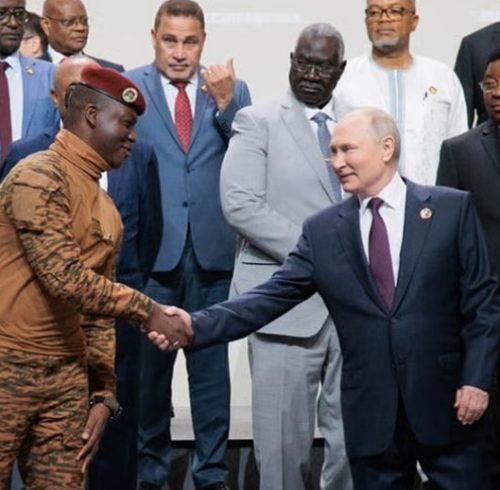
The reanimation of Revolutionary States, as in Africa with Burkina Faso, Mali – and Niger more recently – is symptomatic of a world conflict where capitalism is decadent. The capitalist economy and its military no longer hold their own against the camp of the planned economies. Any Revolutionary State arising from the need of economic development wants the involvement of the Workers States in order to continue further.
The participation of the Russian and Chinese economies in the countries of Africa for instance, raise these countries up to the economic levels achieved in the Workers States. China introduces technologies, and in part Russia too. This is the Permanent Revolution at work – “from tribalism directly to Socialism” as J Posadas used to say – and onwards in the direction of planned economies. Because this process is incompatible with bourgeois ‘democracy’, revolutionary governments keep appearing in the new African nations, and revolutionary ideology keeps gaining ground in those governments.
The growing unification of Russia and China alters the world balance of forces. It grows to the detriment of a dying imperialism whose historic function is ending. The central role of Russia and China in the construction of the BRICS for instance, instills alarm in imperialism. So does the new Chinese path against US hegemony. Backed by the US, the genocide of the Netanyahu’s fascist government in Gaza wants to paralyse and cower the populations. It does it through hunger, terror and murder, preludes to the war of imperialism against humanity. But the Workers States and the Revolutionary States keep proving that another world is possible – of social justice, of intelligence and reason.
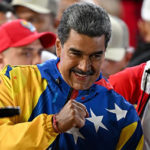
In many parts of Latin America also, Revolutionary States and Workers States have either been maintained or have developed. The most prominent examples are Venezuela, Colombia, Nicaragua, Cuba. These countries have firmly supported the resistance of the Palestinian people. They have voted at the UN for the recognition of a Palestinian State. Now Presidents Petro (Colombia) and Maduro (Venezuela) call for the setting up of military brigades on the International Brigades’ model created in 1938 to fight against Spanish fascism. Petro calls for the withdrawal of Nato from his country, and the closure of the US military bases.
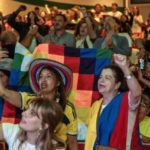
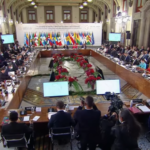
Although under attack by US imperialism, the Bolivarian Republic of Venezuela not only organises the resistance of all its population, but goes on developing simultaneously the measures that allow for socialist advance. It was in Caracas that the First Antifascist International for a New World was founded in Sept 2024. 1,200 representatives attended from the progressive movements of 97 countries. They aim to create tools to combat the reactionary plans of imperialism and NATO. Faced with military aggressions in Venezuela, and imperialism’s deployment to invade the Caribbean, Russia and China have spoken in defence of Venezuela’s sovereignty. They warn the US government not to go any further, or risk intervention.
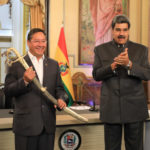
The presence of Nicolás Maduro in Moscow on Victory Day, 9 May 2025, highlighted the growing unity between a Revolutionary State like Venezuela and the Workers States of Russia, China, North Korea, and Cuba. The conditions are favourable to a return to proletarian internationalism and a Communist International. In the teeth of the nuclear war, these conditions reflect the level of security existing in humanity, its confidence in its own future.
There is no possible comparison between the Russian policies of the 1990s and those of today. The decision by the Putin’s government to resume the task of crushing Nazism, and this time on a global scale, is also a proof of partial regeneration in the Russian Federation. It demonstrates that, despite its most strenuous efforts, imperialism has failed to wipe out all the power and all the experience of the Soviet Workers State.
This regeneration in the Russian Federation is not an initiative of the Putin’s leadership. But this leadership cannot ignore that Russia must recover all the basic capabilities of the Workers State, not only to defeat world imperialism and its nuclear war, but to continue to develop the economy. This is why the Russian leadership feels the need to work in solidarity with China and allies. The principles of the Workers State were put in place during the first seven years of Soviet functioning in the USSR. They are principles of the sort that no imperialist war or violence could eradicate.
The task is to assist this process of regeneration therefore, and not just dwell on the limitations. This can be done, for instance, by proposing the unification of the existing Antifascist Internationals – the one in Moscow born in 2022, and the Anti-Fascist International born in Caracas in 2024. One can also contribute by reviving Hugo Chávez’s proposal for a Fifth International.
The remaking of an International was already the perspective offered by J. Posadas when he advocated for the “Mass Communist International” or the “International of Humanity.”
The Posadists Today, 5th Jan 2026 – Revised 27th Feb 2026.
&.&.&.&.&
Chapters in the actual book by J Posadas, obtainable on demand in pdf:
- Partial Regeneration, Historic Reencounter and Permanent Revolution in this stage, 27.8.1971
- Class struggle, the construction of the Workers State, the degeneration and the Partial Regeneration, 14.2.1975
- Extension of the Workers State and changes in the bureaucracy, 29.3.1981.
(1) Vladimir Lenin used the phrase “Workers State” repeatedly in his book “State and Revolution” (August-September 1917) and in countless speeches and writings afterwards.
(2) In 2023, a US government website reported: “Russian healthcare has shown some improvements over the last 10 years, particularly in public health metrics like reduced adult and infant mortality, but significant challenges remain. Key improvements include a longer life expectancy and better survival rates, attributed to factors like improved healthcare quality, pharmaceutical reforms, and public health campaigns against issues like smoking and alcohol poisoning. [..]”. https://pmc.ncbi.nlm.nih.gov/articles/PMC10116466/