Here goes:
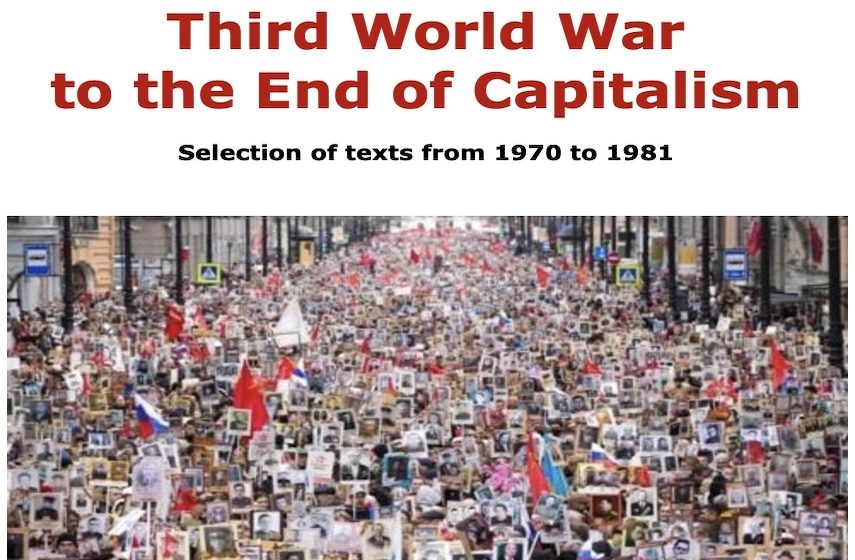
From the Third World War to the End of Capitalism
J POSADAS
PRESENTATION
The book contains a selection of J Posadas’ texts on the fundamental question of the inevitability of war on the part of the capitalist regime – and consequently the inevitability of a third world war. It is vital therefore for humanity to put an end to the capitalist regime. The selected documents originate from multiple conferences and meetings that J Posadas held from 1970 until the year of his death in 1981. Some texts have already been published in the International Scientific Cultural and Political Editions (ISCPEs) in books like: “The Soviet Union”, “Workers’ State and Socialist Society”, “The Crisis of Capitalism, War and Socialism”.
We publish also Leon Trotsky’s “The USSR in War”, dated 25 September 1939. That year, the Second World War had started on 1 September, and on that day, Hitler had invaded Poland from the West. It was only later, and in defence of the USSR, that the Soviet army entered Poland from the East, on 17 September.
As Trotsky wrote The USSR in War eight days after the Soviet entry in Poland, his reference to “the occupied territories” is about Poland, and not about Finland. There, the USSR entered on 30 November 1939, 3 months after Trotsky’s article.
Trotsky was to look back on the subject of Finland however, in April 1940, in his text “Balance Sheet of the Finnish Events”. It was only four months later that he was assassinated in Mexico.
In his text The USSR in War, Trotsky expressed his conviction that, with the Second World War, the revolution would expand again, consolidate the Soviet Workers State and eliminate the factors that had given cause and justification to the rise of bureaucracy in the USSR. Here, Trotsky demonstrated not only his complete confidence in the role of the proletariat as the class that can lead the transition from bourgeois society to socialism, but the impossibility for the bureaucracy to transform itself into a class.
Murdered in August 1940, Trotsky did not see the outcome of the war; but all his analyses and previsions have been amply verified: the world revolution did expand, and the power of the bureaucracy was weakened as a result. This did not bring the end of the capitalist system, but the class struggle brought in new relations of world forces favourable to socialism, impairing the relations in the capitalist camp. This was analysed by J Posadas when he showed how the Second World War had precipitated the rise of new Workers States and Revolutionary States.
With this publication, our aim is to contribute to understand and intervene in the current revolutionary processes. In particular, we aim at intervening in the context of the on-going war in Ukraine. For it is not a war between two countries. It is not the war Russia vs Ukraine. It is the war NATO vs Russia, in a process that concerns the masses of the whole world. This war did not start either with the Russian ‘Special Military Operation’ in Ukraine (SMO) on 22.2.2022. With the dissolution of the USSR now behind us, the SMO returns a deal of socialist hope to the historic process.
Many factors led Russia to the extreme decision of the SMO in Ukraine. To profit from the crisis and enfeeblement consequent on the USSR’s dissolution, Nato embarked upon its sanguinary enlargement. This was marked by its wars of occupation and rapine: in Europe (Yugoslavia), the Middle East (Iraq, Syria, Afghanistan), in Africa (Libya). In the former Soviet Republics, Nato stimulated internal conflicts to press its “Nato frontiers” closer to Russia, in hope of suffocating it. Having effectively appropriated most of Ukraine, Nato has turned that country into a ‘special’ military base, to attack Russia from there and try to destroy it.
Russia’s SMO in Ukraine is a legitimate response. It stands as a powerful warning that the end draws near for unpunished imperialist war. The SMO stands also as a call to the world’s peoples to trust in the possibility of a World Front to break the hegemony that imperialism can only maintain through NATO.
There are no more “neutral” countries in Europe. Directly or indirectly, Finland, Sweden, Switzerland have joined the NATO military alliance. It matters today that one should discuss this clearly, and unite against NATO preparing for war on the scale of the world, with nuclear weapons’ use included.
No nation stands outside this process. The masses of the world do not want to pay for the crisis of the capitalist system. They want no truck in its war preparations against Russia or China. In all the communist parties, the socialist parties, the progressive and revolutionary nationalist movements of the world, in all the movements for peace and the environmentalists, the need grows to discuss this in depth and unite globally.
We salute all the initiatives to build an anti-war world front. Our Editorial participates in it with the publication of these important texts by J. Posadas and León Trotsky.
ISCPE, Oct 2022. Updated Feb 2024
Who is J. Posadas?
J. Posadas was born in Argentina in 1912 and died in Italy in 1981. He began his activities as a trade union leader in the footwear sector. He soon adopted Trotsky’s ideas and joined the Fourth International. He then developed as a writer, theorist, political leader and revolutionary organizer. In 1947 he organized the Fourth International Group (GCI) and started the newspaper Voz Proletaria in light of the birth of revolutionary nationalism with Peronism in Argentina. He wrote major works such as “Plan Quinquenal or Permanent Revolution” and “El Peronismo” 1963, and “From Nationalism to the Workers State” 1966.
In 1962, J. Posadas created the Trotskyist-Posadist Fourth International with some of his fundamental texts: “The Construction of the Workers’ State and from the Workers State to Socialism”; “The role of the USSR in History”; “The Living Thought of Trotsky”, and “Partial Regeneration, Historic Re-encounter and the Process of Permanent Revolution in this stage”.
In the more general field of art, science and culture, the author has left many writings that incorporate into the Marxist analysis themes ranging from ‘the human relations’ to ‘the communist future of humanity’. This formed part of his History of Human Civilization left unfinished due to his unexpected death in 1981.
Faced with the implacable and historic antagonism between the capitalist system and the Workers States, J. Posadas upheld Trotsky’s ‘unconditional defence of the Workers State’, and analysed the inevitability of the atomic war. He devoted his whole life, and all his work, to giving to humanity confidence in its ability to organize in order to triumph, like Vietnam did, and to defeat world imperialism even in its own imperialist armies.
Some of his last words before he died were: “Life without the struggle for socialism has no sense, with all the consequences”.
International Scientific, Cultural & Political Editions, IECCP – Suite 252, 61 Praed St, London W2 1NS.