Posadists Today publish this article by Thierry Deronne[1] of Venezuela because it highlights the anti-imperialist maturity and resistance of the population of Venezuela. It also gives the lie to everything to be found in the bourgeois medias against the government of Nicolas Maduro.
Parliamentary elections were held on 25 May 2025 to choose the 285 deputies of the National Assembly. The ruling United Socialist Party of Venezuela (PSUV) led by Nicolas Maduro won the parliamentary and regional elections by a landslide. It won 23 out of 24 state governor positions, whilst 16 municipalities lost to the PSUV in 2021 have now returned to it.
In these May 2025 elections, the Communist Party of Venezuela’s new president, Henry Parra, implemented a strategy of support for the pro-Maduro ‘Gran Polo Patriotico’ which the PCV had left when it had been led by Oscar Figuera, after Chavez’ death. This electoral return of the PCV to the Gran Polo has contributed to the landslide in support of the PSUV in these 2025 elections.
The political rectification of the Communist Party of Venezuela strengthens the Revolutionary State of Venezuela against the vitriolic attacks and renewed sanctions of US Imperialism. In 2024, the extreme-right-wing and pro-imperialist Orlando Moreno, had led the presidential campaign for Venezuela’s opposition coalition in the costal state of Delta Amacuro which borders the Essequibo. In these 2025 elections, Donald Trump and Marco Rubio threatened to register as ‘enemy’ anyone in the Essequibo daring to take part in the governorship elections, which were nevertheless won by Neil Jesús Villamizar Sánchez for the PSUV.[2]
Posadists Today, published 23.2.2026
Start of the article written by Thierry Deronne:
In recent years, activists from all over the world have regularly received statements signed “Venezuelan Communist Party” denouncing “the neoliberal regime of Maduro that persecutes the communists, represses the workers, crashes the wages and sows terror in popular circles the way fascism does“. With automatic solidarity and often in good faith, these activists pass on such messages without suspecting the true nature of the source or of the disinformation. Because not only does the real Venezuelan Communist Party support actively the Bolivarian revolution and regroups the vast majority of the activists, it has also just achieved historic results in the legislative elections of May 2025.
A little bit of history…
Founded in 1931, the PCV never became the spearhead of the proletariat. It developed in one of those vacant niches of the pluralistic façade gratifying to the Petro-Rentière oligarchy – something between Social Democracy and Christian Democracy. The opportunism of the PCV and with its eternal 1.5% electoral results had a way to annoy in their turn both Fidel Castro and Hugo Chávez.
One of the problems of the pre-Chávez left resided in having been led by sons of the bourgeoisie. In a curious synthesis of colonialism and Marxism, the population was for them “an alienated mass to whom the political line must be handed down“. Some saw themselves as the new Fidel Castro or Che Guevara, but they left behind graveyards of martyrs, students, peasant families sacrificed in the struggle, and many disappointed hopes.
Tired of the “big day” never arriving, the Venezuelan people finally turned to the one who knew how to listen, and talk to them – a certain Hugo Chávez. In the prison where his civic-military insurrection against government corruption had taken him, this brown-skinned soldier of modest origins understood that revolution would not come from these leftist minorities too far from the masses. The time had come to “dig up the dead mango-seed, and sow a new one” (1).
In popular memory, his “Simon Bolivar National Project” brings new life to three anti-colonial roots: Bolivar, Rodriguez, Zamora[3].
The civil and military alliance of patriots speaks of the képi screwed on the peasant hat of Ezequiel Zamora, the general “of Tierra y Hombres Libres” (1817-1860). The philosopher Simon Rodriguez (1769-1854) asked of “the America freed from the Spanish yoke” (by his former student Simon Bolivar), “to invent, to be original, to no longer copy old Europe“. The political model in his mind was “Toparquia”, a communard government for each territory of the Republic[4].
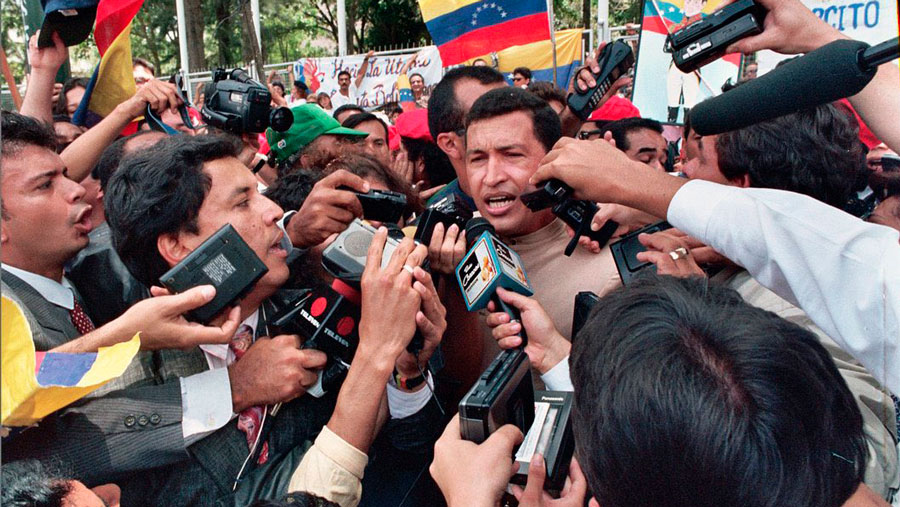
The political prisoner Hugo Chávez comes out of his Yare prison in 1994.
Amnestied in 1994, the Bolivarian soldier Hugo Chavez opts for the electoral road and begins a national tour. Everywhere, the crowds listen to him attentively. His strong popularity irritates the leadership of the Communist Party PCV. Later, Chávez will tell Ignacio Ramonet[5]: “When I got out of prison, the Secretary General of the Communist Party (PCV) [Oscar Figuera], said that ‘the presence of caudillo Chávez harms the popular movement’. The PCV leaders stopped me even participating in marches and demonstrations. They had understood nothing. All you could see in them was electoral recuperation and opportunism” (2). In 1999, the always-already excluded masses finally enter politics by having Chávez for President. The PCV cannot not digest that the “alienated people” should prefer the son of rural masters, but it still climbs on the Bolivarian bandwagon and sticks Chávez’ photos on its posters to increase its votes. It demands ministerial roles here, embassy ones there. Its secret hope is that this Bolivarian revolution parenthesis will close, and that it will be again the only party on the left.
The breath of Chavist egalitarian life blows deeply over the political landscape, keeping the support of the electorate. In 2020, the Secretary General of the PCV, Oscar Figuera, declares suddenly that “21st century socialism is not a scientific doctrine” and that “Nicolas Maduro is not a Chavist but a neoliberal”. The party’s base criticises this change and expresses concern about the loss of activists to Chavism (3). Figuera turns a deaf ear, and to secure his position at the head of the party, he convenes a Congress limited to 80 “faithful” members instead of the usual 400 delegates. In 2023, a group of activists take this matter to the Supreme Court of Venezuela, where they finally win their case. Under the chairmanship of militant activist Henry Parra, a transitional communist leadership is appointed to organize a PCV Congress in line with the legal statutes of the country. In press releases intended for the international listings of the brother [communist] parties, Figuera thunders: “Mercenaries of dictator Maduro!”. Then comes the start of purge of the ‘traitors’ from the party, and this declaration: “After a long investigation, the plenum of our Central Committee discovered that the historical leaders of our International Relations Department – the deputies (MPs) Carolus Wimmer and Ursula Aguilera – were actually traitors in the service of the Maduro regime” (4).
From rebirth to electoral winnings for the new PCV
While hardly any mobilisation could be seen in support of former general secretary (Figuera), the new leadership of Henry Parra revived the party’s basic functions. This quickly attracted the Party’s sections and cells from all over the country, eager as they were to make up for lost time, to rebuild the party. The militants returned to the Chavista coalition. They threw their forces into the May 2025 legislative campaign, a strategy acclaimed by the voters. [In so doing], the PCV has made a historic leap. It has gone from one single MP in the National Assembly to six – having won 5 seats. In number of votes garnered, it becomes the third party out of the 46 parties in the running.
Parra comments on the victory as follows: “The stronger the Communist Party, the stronger the Bolivarian revolution. We keep our identity: the PSUV[6] bets more on the commune as a revolutionary engine, and we bet more on the working class. Many communist parties in Latin America have understood Figuera’s manipulation. See how he lines up with the extreme right. We are going to organize the party Congress and reconnect with our sister parties around the world.” – “Reasons why we support Maduro? Its anti-imperialism. Its socialist program. Its proletarian origin. Its capacity to guarantee peace, because however much we respect our political opponents, we know that any return to power of the extreme right will want to eliminate us, same as in the anti-Chávez coup in 2002”.
Long before the electoral success of the new PCV leadership in Venezuela, and without having fallen into any trap of the Figuera’s campaigns, communist parties around the world maintained their solidarity with the revolutionary government of Nicolas Maduro. This is the case of the Cuban, Chinese, Vietnamese, Nepalese, South African, Colombian, Peruvian, Argentine, Brazilian (PCdoB), South Korean (PDP), Filipino, Spanish, Portuguese Communist Parties, the Party for Socialism and Liberation (United States) and nearly 80 communist organizations grouped together within the World Anti-Imperialist Platform (5). Not to mention social movements or research centers of Marxist inspiration, such as the Movement of Landless Workers of Brazil, the Tricontinental Institute directed by the Indian historian Vijay Prashad, the International People’s Assembly, the People’s Forum (United States), etc…
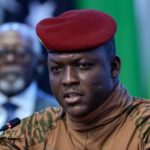
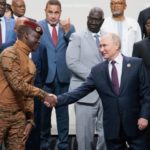
Photos: in June 2025, Nicolas Maduro receives Wu Hansheng, from the Department of Social Work of the Chinese Communist Party. The 5th visit of the Bolivarian President to China (2023) made it possible to sign an “all-weather” strategic partnership with President Xi Jinping and to strengthen cooperation between the Unified Socialist Party of Venezuela (PSUV) and the Chinese Communist Party for the eradication of poverty. In April 2025, Maduro met with the Communist Youth of Vietnam, also here to strengthen cooperation. In Moscow, in May 2025, on the 80th anniversary of the victory over Nazism, he met Cuban President Diaz-Canel: the PSUV and the Cuban Communist Party have long been cooperating at the highest level. Maduro immediately met his counterparts Vladimir Putin and Captain Traoré, President of Burkina Faso, with whom he signed several cooperation agreements.
Figuera in his maze
After supporting the right-wing candidate Enrique Marquez in the 2024 presidential elections and then refusing to recognize the victory of the “dictator” Maduro, the former general secretary of the PCV refused, like the extreme right, to participate in the legislative elections of April 2025 or the municipal elections of July 2025: “in this context of lack of guarantees and political repression, we will not participate in the elections, which are only a farce”. (6) Fear of being sanctioned by voters and falling lower than the eternal 1.5%? As for the anti-fascist international meetings that have brought together hundreds of parties and social movements from around the world for two years in Caracas, they are for him only “the will of the regime to hide its authoritarian and anti-democratic character”. (7)
The rite is immutable. In front of a camera, surrounded by his close guard, Figuera reads yet another statement against the “neo-liberal- dictatorship of Maduro”. We think of Roque Dalton’s poem about a central committee too busy writing its press release on “the-current-situation-and-our-tasks” to see that in the street, the people are making the revolution. We remember the Mexican communists who decreed that Sandino was a “liberal caudillo” and an “adventurer”, or the Bolivian communists who refused to support the Che guerrilla. Same quiet arrogance of those who call themselves unique holders of the direct line with Marx, same inflated rhetoric of the 50s, repeated regardless of any context. A scene so caricatured that we wonder “how dare they still”? (8)
Photos: the “communist” Oscar Figuera in his works. Adobant for the 2024 presidential elections the right-wing candidate Enrique Marquez. Protesting against the ineligibility of the far-right coup Maria Corina Machado – oligarch, candidate of the Likud and Washington, who wrote to Netanyahu to ask him to intervene militarily against Maduro. Denouncing Maduro’s “dictatorial practices” with the director of Provea, an originally apolitical and human rights-centered NGO, now openly opposed to the revolution. Or denouncing Maduro’s “dictatorship” live on EVTV, the Venezuelan far-right television based in Miami.
While professing a routine anti-imperialism (verbal criticism of the blockade against Cuba), Figuera reserves for the Bolivarian revolution the same technique as the media: erasing the causes to substitute their effects. According to him, the “crisis” is caused by “Maduro’s neoliberalism that crushes workers’ wages”. Exit, the financial blockade that prevents the Bolivarian government from buying medicines, resulting in the death of 100,000 patients. Exit, the more than 1000 sanctions imposed by the United States (9) that caused Venezuela to lose 95% of its income and generated a massive exodus (which the media attribute to the “failure of socialism”): “The low wages, the reduction of public spending and the privatization attempts framed in the anti-blockade law are expressions of this neoliberalism that confirm Maduro’s distance from Chavism”.
Let’s stop the scratched disc for a second. Why would President Maduro suddenly decide to become “neoliberal” and “crush wages”? By desire to betray the Bolivarian revolution that had brought the wages of workers to the highest level of the continent? For the pleasure of becoming unpopular? In reality, in the face of the Western blockade, Maduro is one of the few heads of state who has not given in to the sirens of austerity. When it began by periodically increasing wages by 25% or 50%, the private sector cancelled these increases by increasing its prices in the same proportion. Faced with the inflationary spiral, Maduro has decided to reactivate the national productive apparatus, thanks to multipolar alliances. Not only to get away from oil rentierism, but also to bail out the state’s coffers, especially by taxing the richest. The Central Bank has thus recovered valuable resources to intervene in the foreign exchange market and defend the currency. All this made it possible to rebuild public services and gradually increase workers’ allowances, while limiting the inflation that cancelled them. A Chinese-style strategy: maintain and strengthen the State as a strategic actor in the economy. (10)
Result: ECLAC (UN) indicates that for four years Venezuela has experienced the highest growth (4%) in South America. For the first time in 150 years of oil history, the country borders on food sovereignty and produces almost 100% of the food it consumes. During the first quarter of 2025, GDP increased by 9.32% and the country increased its non-oil exports by more than 87%. (11)
When, in February 2025, Donald Trump revoked Chevron’s license to tighten Venezuela’s economy a little more in the throat, Maduro responded by extending the market to Asia and giving housing number 5 million 258 miles to a popular family. On May 1, 2025, he increased the “allowance against economic war” from $90 to $120 for 20 million families. With the $40 alimony allowance, that’s $160 paid each month as a supplement to the base salary. In the private sector – majority – the minimum wage is about 200 dollars. Important point when studying purchasing power in Venezuela: despite Western sanctions, and unlike neoliberal regimes, public services and basic necessities are very cheap in Venezuela. Subsidized gasoline, the cheapest in the world ($0.5/liter), water, gas, electricity, internet, subway, etc.. are accessible at low prices. The food given monthly by the government to the population in response to the blockade, costs only 5% of the market price. Many health centers, as well as public education and culture, operate free of charge (12).
While in the West, a growing number of families can no longer make ends meet, Venezuelan workers are flocking to shops and “entrepreneurships” that open every day. Caracas is invaded by commercial music and traffic jams form very early around the giant malls (13). Thousands of Venezuelan migrants fled the impoverishment they suffer in the “host countries” and returned home thanks to the public and free airline, long before the expulsions and human rights violations committed by the Trump regime (14). But the imperturbable ex-leader of the PCV keeps his verdict: “The Political Bureau of the Central Committee of the Communist Party of Venezuela considers that after the announcements made on May 1, the salaries and pensions of Venezuelans have been reduced to zero. “(15)
Surfing the image built by the media
When legal mafias linked to public or private companies violate human rights, the former PCV leader automatically makes Maduro responsible. “Maduro sows terror in popular circles as fascism does.” It is Figuera’s ad-hominem obsession that surfs on the image sedimented for twenty years by the capitalist media. Because if it is true that there are workers in Venezuela unjustly imprisoned, raising the legitimate struggles of social movements to obtain their release, these human rights violations do not embody a government policy.
It is not in Maduro’s Venezuela but in Ignacio Lula da Silva’s Brazil that “violence in the countryside reached a record level in 2024 and regions where agribusiness is progressing concentrate cases of murder”. It was not in Maduro’s Venezuela but in Gustavo Petro’s Colombia that “in 2024, a social leader was killed every two days – whether he was a human rights activist, trade unionist, Afro-descendant activist, peasant leader, etc…” and that “in 2025 70 social leaders were murdered”. It is not in Maduro’s Venezuela but in Claudia Sheinbaum’s Mexico “that in 2024, 125,000 people are missing” and that clandestine mass graves are regularly discovered. Should we deduce that Lula, Petro or Sheinbaum’s policy is to encourage these human rights violations? (16)
In Venezuela, Maduro has repeatedly publicly reprimanded law enforcement officers subbed by large landowners to expel peasants and put an end to the murders of activists engaged in agrarian reform, frequent at the time of Chávez (17). Attorney General Tarek William Saab dismissed hundreds of corrupt judges or easy-triggered police officers. For Chilean communist mayor Daniel Jadue, victim of Lawfare and imprisoned in his country for setting up a network of popular pharmacies: “the Bolivarian process has been able to arrest and condemn hundreds of security force officers for human rights violations, for disobeying orders and using firearms during the violence of the extreme right, while in Chile no security forces officer who repressed the social movement was arrested or tried” (18)
Let’s talk about democracy. Maduro does not just just reform like those of his progressive neighbours. On May 25, 2025, after the large victory of the Chavista coalition in the legislative elections, he announced the resumption of the strategic plan: building a new state based on popular self-government. Citizens’ assemblies are held across the country to collect proposals for this constitutional reform. The objective, explains the Bolivarian president, is to “build a modern democracy based on the direct participation of citizens, the power of social movements, and the community. A great process of expanded democratization of Venezuelan society, of political, institutional, economic, social, cultural and educational life. Because a system that elects the one who has the most money to control TikTok, Instagram, radio and television, is not a democracy, but a farce, a theatre of the absurd. Venezuela does not want it, because its entire history is imbued with the idea and desire for an authentic democracy.” (19).
When Figuera denounces that “dictator Maduro sows terror as fascism does”, should we see in his speech the hand of the USAID or the NED (20)? Certainly, it gravitates in the NGO ecosystem of “human rights” that have drifted like PROVEA towards the open political opposition against the Bolivarian revolution and against its constituent assemblies. NGOs that manufacture “political prisoners” files for the media and for the mafias of the Venezuelan right in the USA. To the point that even the Trump administration has distanced itself from this trade (21). But the explanation is probably more mediocre. Before the July 2024 presidential elections, the far-right Machado announced that in case of victory, she would make the Chavists pay (“carcar”). Clearly, that she would eliminate them. Did the former leader of the PCV make an electoral non-aggression pact with her in the hope that Chavism, defeated at the polls, would disappear? And that the PCV would once again become the only left-wing party? A not so crazy hypothesis when we know the sectarianism and opportunism of Figuera.
The struggle between the old and the new
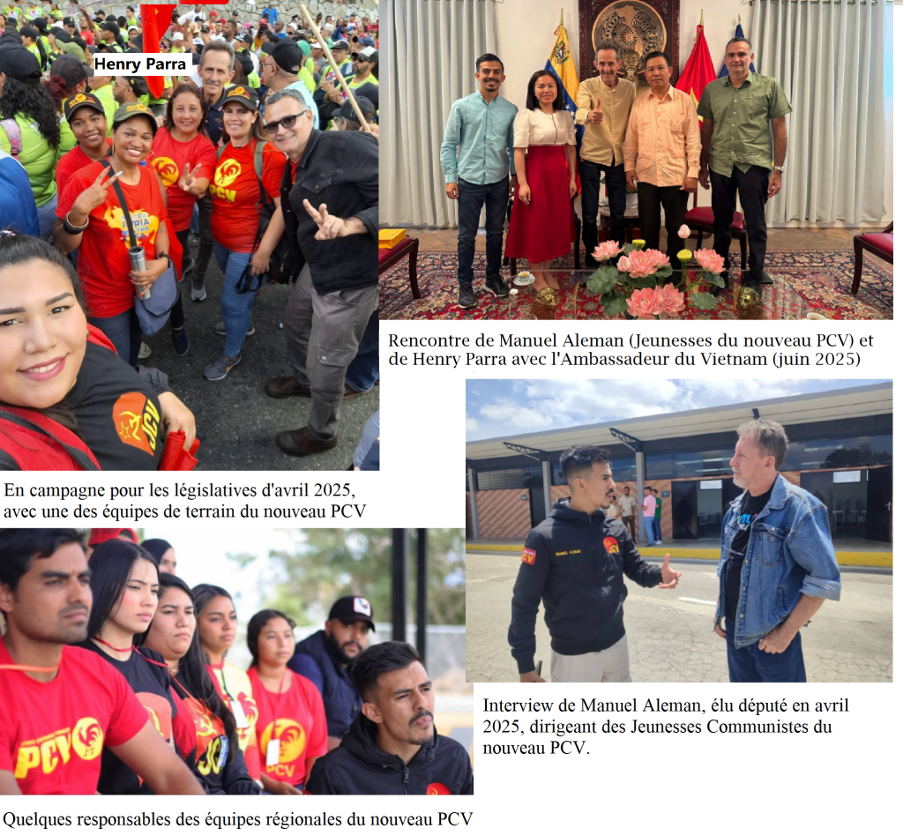
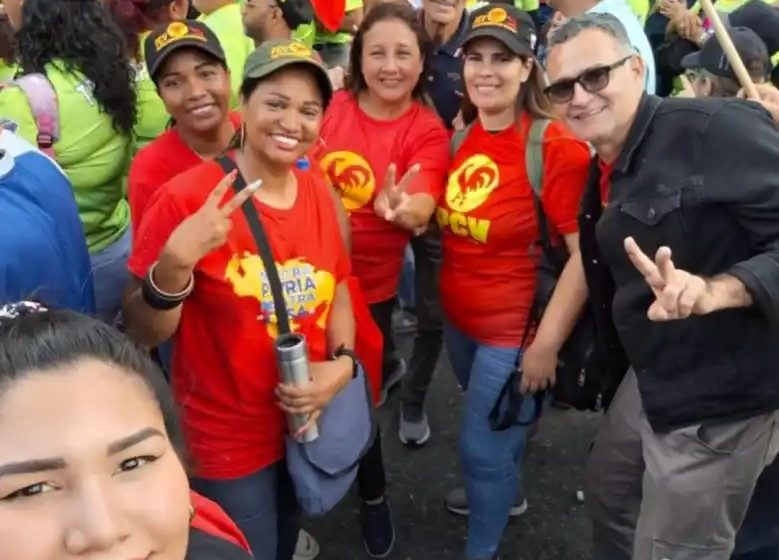
Photos: Henry Parra, the new president of the PCV – campaigning with one of the field teams for the April 2025 legislative elections or at the Embassy of Vietnam, in June 2025. The Communist Youth, and their leader Manuel Aleman, explain to us their desire to work with popular self-governments: “how can we not support the municipalities where the people organize and vote according to their own interests? “
If, for twenty years, media empires have made Venezuela a “dictatorship”, it is because it is necessary to prevent the contagion of this democratising machine that is the Bolivarian revolution. For journalist Maurice Lemoine, “at the risk of surprising Venezuela’s despisers, its thousands of popular self-governments are the most ambitious participatory democracy experience on the continent – and probably even from far beyond. The media tolerate local experiences (zapatism, Rojava, etc.) but must hide this “revolution in the revolution” that threatens the system and impresses many intellectuals and movements in the global South. For the director of the Tricontinental Institute, Indian historian Vijay Prashad, “in Venezuela, the municipalities forged in popular neighbourhoods play a central role in the constitution of new ideas and material forces that move society forward. For Puerto Rican decolonial sociologist Ramon Grosfoguel, “perhaps with all the difficulties that the Empire has created in Venezuela, we lose sight of the historical moment and what it is building in the communes and that does not exist anywhere else in Latin America”. For the international coordinator of the Landless Movement of Brazil, Messilene Gorete: “sometimes, on the left, we have very closed schemes on the level of preparation and planning necessary to move forward, and this can become an obstacle. Creativity – in a country where people are very spontaneous – is a great virtue of the Bolivarian revolution. Here, the people are really the subject of the revolution. And the Venezuelan municipality is a model that our continent needs. Feminist activist Marta Martin Moran, responsible for Latin America at the Spanish PC, who has observed a dozen electoral processes in Venezuela, does not hide her enthusiasm about the quarterly consultations by which the population of each municipality chooses the project that the State must finance. Mexican feminist sociologist Karina Ochoa highlights the central and majority role of women, “concerned to substitute power-for power-on”. (22).
Every normally constituted communist learnt with Marx and Lenin that the commune is the “political form, finally discovered, under which we can work on the matter of the economic emancipation of work”; and that after destroying the bourgeois state, the next thing is the most difficult: to create a new form of state where “everyone is going to govern in turn, and soon will get used to the idea that no one is governing”.
During the time when the Young Communists of the new PCV were welcoming the new political spaces in the municipalities, the former PCV General Secretary Figuera expressed only indifference for this new State in gestation. With a contempt similar to that coming from the right, which systematically voted against all the laws transferring power to popular self-government. From under its thick layer of racism, the Venezuelan right-wing grasps well that so many emancipation tools in the hands of the peoples, make it more anachronistic every day.
Thierry Deronne, Caracas, June 17, 2025.
Sources:
Notes:
- Hugo Chávez’s speech in Havana, December 1994,https://www.youtube.com/watch? v=oVLwamajpXo
- “Allow utopia, organize the impossible” – My first life, by Hugo Chávez (Conversations with Ignacio Ramonet),https://venezuelainfos.wordpress.com/2015/07/11/permettre-lutopie-organiser-limpossible-ma-premiere-vie-par-hugo-chavez-conversations-avec-ignacio-ramonet/. A few years later, in a different context, Gustavo Petro makes the same analysis: “The Colombian left never won the presidency because it was too small, too withdrawn and too sectarian. The group ego is very harmful with its “correct and purist line” and its way of looking with distrust at any Colombian or Colombian who does not look like a left-wing executive, whom we once called a revolutionary framework.”https://ultimasnoticias.com.ve/mundo/petro-pone-en-duda-continuidad-de-benedetti-en-el-cargo/
- Already in 2018, at a national congress of the PC, the surviving guerrillas of the 60s had left the room to denounce this anti-Maduro drift: “it is for this revolution that we all fought, so stop insulting those who died for it! ” they had launched to Oscar Figuera.
- See Figuera’s press release justifying this purge, distributed without reservation by sites like Solidnet: http://solidnet.org/article/CP-of-Venezuela-On-the-expulsion-of-Carolus-Wimmer-and-Ursula-Aguilera-from-the-PCVs-ranks/ orhttps://mouvementcommuniste.over-blog.com/2024/08/parti-communiste-du-venezuela-sur-l-expulsion-de-carolus-wimmer-et-ursula-aguilera-des-rangs-du-parti.html
- “Caracas 3rd International Conference in March 2023: Latin America has a vital role to play in the world anti-imperialist struggle“, https://wap21.org/? p=2332
- “Avalanche of irregularities plunges May 25 electoral process into the abyss“,https://prensapcv.wordpress.com/2025/05/08/avalanche-of-irregularities-plunges-may-25-electoral-process-into-the-abysss/; El Partido Comunista de Venezuela rechaza la candidatura de Maduro y apoya la de Enrique Márquez,https://cnnespanol.cnn.com/video/candidatura-enrique-marquez-partido-comunista-venezuela-cafe-tv and “El Partido Comunista de Venezuela anuncia de decisión de no participar en comicios de julio”, https://www.infoswiss.ch/spa/el-partido-comunista-de-venezuela-anuncia-decisi%C3%B3n-de-no-participar-en-comicios-de-julio/89500806
- “PCV: Maduro tries to recompose his bad legitimacy with anti-fascist parliamentary forum“, https://prensapcv.wordpress.com/2024/11/05/pcv-maduro-trata-de-recomponer-su-malograda-legitimidad-con-foro-parlamentario-antifascista/
- The “Figuera case” is just one example of the influence of the Greek Communist Party that divides or paralyzes communist organizations around the world by propagating a “chemically pure” criticism of political processes. Any process that does not enter the grid of Marxism classics is denounced as “reformist” or “imperialist”. Thus China or Mexico, or Venezuela, etc…, since they are mixed economies, are traitors who make pacts with capitalism, and since capitalism is imperialist… are imperialist regimes too! With regard to the conflict in Ukraine, this Trotskyist current erases the causal sequence (pro-Western coup in Maidan in 2014, bombing of the Russian-speaking populations of Donbass and Lugansk, lure of the Minsk agreements, installation of missiles and NATO biological bases on the Russian border, etc…) to be able to make Russia an “imperialism” identical to that of the United States.
- “They are making Venezuela’s economy scream“, https://peoplesdispatch.org/2025/05/06/they-are-making-venezuelas-economy-scream/, “Sanções contra Venezuela fizeram o país perder US$ 226 bi em receitas petrolíferas“, https://www.brasildefato.com.br/colunista/vijay-prashad/2025/05/06/sancoes-contra-venezuela-fizeram-o-pais-perder-us-226-bi-em-receitas-petroliferas/, “Venezuela. UN recognizes negative impact of unilateral coercive measures of the USA”,https://www.resumenlatinoamericano.org/2025/04/02/venezuela-onu-reconoce-impacto-negativo-de-las-medidas-coercitivas-unilaterales-de-ee-uu/
- “Is Nicolas Maduro become neo-liberal?”, https://venezuelainfos.wordpress.com/2023/04/21/nicolas-maduro-est-il-devenu-neo-liberal/. For the complete sequence since the beginning of the economic war: “May 2011: increase in the minimum wage of 25% and the wages of academics and the public sector by 40%“,https://venezuelainfos.wordpress.com/2012/02/15/augmententation-du-salire-minimu-de-de-25-et-des-salaires-universitaires-et-du-secteur-public-40/; “Venezuela: the wage increase and the decrease in unemployment continue“,https://venezuelainfos.wordpress.com/2014/01/22/laugmentation-du-salaire-e-la-baisse-du-chomage-continuent/; “Control of food prices, wage increase, tax on large fortunes and liberation of the dollar: Maduro continues the offensive against the economic war“,https://venezuelainfos.wordpress.com/2017/09/11/controle-des-prix-des-aliments-hausse-du-salaire- frenar los recursos para el pueblo »,https://ultimasnoticias.com.ve/politica/malas-noticias-al-imperio-no-podran-frenar-los-recursos-para-el-pueblo/
- “ECPAL: Venezuela destaca como la economía de mayor crecimiento en la región“, https://observatorio.gob.ve/cepal-venezuela-destaca-como-la-economia-de-mayor-crecimiento-en-la-region/; “La economía continua continua avanzando: El PIB grew 9.32% en el primer trimestre del primer trimestre de 2025“,https://www.bcv.org.ve/notas-prensa/la-venezolana-continua-avanzando-el-el-pib-crecio-932-el-primer-primer-trimestre, “97% de los productos que se venden en en supermarkets in Venezuela“,https://ultimasnoticias.com.ve/mercado/97-de-de-productos-se-en-en-los-supermercados-son-hechos-en-venezuela/; “Venezuela maintains solide crecimiento en soberanía alimentaria durante primer semestre del 2025“,https://
- “Un país que se self-altostestece y exporta: Venezuela rompe criminales sanciones y alcanzar soberanía alimentaria“, https://fusernews.com/un-pais-que-se-autoabastece-y-exporta-venezuela-rompe-criminales-sanciones-y-alcanza-soberania-alimentaria/, “Sistema Agroalimentario venezolano reporta mejoras en abastecimiento y almacenamiento al cierre de mayo“, https://venezuela-news.com/sistema-agroalimentario-reporta-mejoras-abastecimiento-almacenamiento-venezuela-durante-mayo/; “Presidente Maduro entregó la vivienda 5 millones 258 mil“, https://www.correodelo.gob.gob.ve/presidente-maduro-entrega-entrego-la-vivienda-5-millones-258-mil/; “Venezuela: School Food Program Serves 4.6 Million Students for Free
- “2024, the year of supermarkets“, https://ultimasnoticias.com.ve/mercado/2024-el-ano-de-lo-supermercados/
- “US Strips Hundreds of Thousands from Cuba, Haiti, Nicaragua and Venezuela of Migratory Status. President Nicolás Maduro appealed to Venezuelan migrants abroad to return home.“, “https://venezuelanalysis.com/news/us-strips-hundreds-of-thousands-from-cuba-haiti-nicaragua-and-venezuela-of-migratory-status/ , “Where are the Venezuelan human rights defenders?”, https://b-tornare.overblog.com/2025/05/ou-sont-les-defenseurs-des-droits-humains-des-venezueliens.html, “Maduro said: “if they don’t want it, we do.”, https://b-tornare.overblog.com/2025/05/ou-sont-les-defenseurs-des-droits-humains-des-venezueliens.html, “Cabello: Más de un millón de venezolanos han tras encontrar la cruda realidad“, https://ultimasnoticias.com
- “PCV: Maduro’s economic policy zeroed wages and pensions”,https://prensapcv.wordpress.com/2025/05/06/pcv-politica-economica-de-maduro-llevo-a-cero-los-salarios-y-las-pensiones/
- “Brazil: 12 dead during a police raid in the city of Salvador“, https://www.lefigaro.fr/flash-actu/bresil-12-morts-lors-d-a-raid-de-la-police-dans-ville-de-salvador-20250305, “Violencia no campo bate recorde da última de última década e áreas de agronegócio concentram campo de casos de assassinatos“,https://www.brasildefato.com.br/2025/04/23/violencia-no-campo-bate-recorde-na-ultima-decada-areas-de-avanco-do-negocio-negocio-concentram-casos-assassinatos/; “Indiagens bloquean carretera en Brasil contra ley que amenaza sus territorios/, “In 2024, un líder social was murdered cada dos días en Colombia“, https://elpais.com/america-colombia/2024/en ONU sobre desapariciones forzadas“, https://www.jornada.com.mx/noticia/2025/04/05/politica/mexico-rechaza-declaraciones-de-comite-de-de-la-onu-sobre-desapariciones-forzadas, “Protestan familiares de desaparecidos en el Senado“,https://www.jornada.com.mx/galeria/2025/04/10/politica/protestan-familiares-de-desaparecidos-en-el-senado, “Madres de todo el país exigen justicia para personas desaparecidas”,https://www.jornada.com.mx/galeria/2025/05/10/politica/madres-de-todo-el-pais-exigen-justicia-para-personas-desaparecidas-en-10-de-mayo, “México que hayadiciones forzadas per parte del Estado“https://www.jornada.com.mx/noticia
- “Nicolas Maduro prohibits any expulsion of peasants and demands to arrest those responsible for these abuses (photos and video)“, https://venezuelainfos.wordpress.com/2018/04/10/nicolas-maduro-interdit-toute-expulsion-de-paysans-et-exige-darreter-les-responsables-de-ces-exactions-photos-et-video/. “Statements by Attorney General Tarek William Saab“https://www.instagram.com/p/DGyTLDLvqKl/
- Statements by Daniel Jadue: https://x.com/venezuelainfos/status/1515071286883540994.
- “In response to the post-democracies of Musk and Trump, Nicolas Maduro strengthens democracy in Venezuela“, https://venezuelainfos.wordpress.com/2025/01/02/a-rebours-des-post-democraties-de-musk-and-trump-nicolas-maduro-renforce-la-democratie-au-venezuela/. The humanism of the Bolivarian revolution is rooted in the maxim of Simon Bolivar “cursed be the soldier who turns his weapons against the people“, cited by Chávez at the time of weaning the Venezuelan army from the School of Americas, the “school of executioners” installed in the United States. Even violent right-wing extremists (restyled into “prisoners of conscience” by the media) who periodically organize destabilizations and recruit young people from popular neighborhoods for a few dollars, end up being released. The leaders of the coup extreme right – from Juan Guaido to Maria Corina Machado – have never been arrested. To the point that we should almost talk about laxity when we compare the action of the Venezuelan justice to that of the Brazilian justice against Bolsonaro’s coup d’état or that of the US justice against the extremists who stormed the Capitol.
- “The Communist Party of Venezuela accuses the Government of executing a “terrorist policy“, https://www.swissinfo.ch/spa/el-partido-comunista-de-venezuela-acusa-al-gobierno-de-ejecutar-una-%22pol%C3%ADtica-de-terror%22/86249124; “National Endowment for Democracy weaponizes “democracy” in Venezuela, Nicaragua and Cuba.“, https://www.laprogressive.com/the-media-in-the-united-states/propaganda-outlet
- “The “Grand Venezuela Circus” and its influencers”, by Maurice Lemoine, https://venezuelainfos.wordpress.com/2024/10/10/le-grand-venezuela-circus-et-ses-influencers-par-maurice-lemoine/ and “Venezuela: Tales and miscounts of curious “human rights defenders”, by Maurice Lemoine“, https://venezuelainfos.wordpress.com/2020/09/30/venezuela-contes-et-mecomptes-de-curieux-defenseurs-des-droits-humains-par-maurice-lemoine/ and “Venezuela: at the “sources” of disinformation“, https://www.medelu.org/Venezuela-aux-sources-de-la-desinformation, “Con ONG las extremists se llenan los bolsillos a costa de la venezolana (+Lista)“, https://ultimasnoticias.ve/politica/con-las-ong
- Lenin Went to Dance in the Snow to Celebrate the Paris Commune and the Soviet Republic: The Twenty-First Newsletter (2021),https://thetricontinental.org/newsletterissue/21-paris-commune/, “We cannot be decolonial without being anti-imperialist”: Ramon Grosfoguel.“,https://venezuelainfos.wordpress.com/2023/05/22/on-ne-peut-etre-decolonial-sans-etre-anti-imperialiste-ramon-grosfoguel/, “The Landless of Brazil at the school of Venezuela: “here, the people are really the subject of the revolution“,https://venezuelainfos.wordpress.com/2022/05/27/les-sans-terre-du-bresil-a-lecole-du-venezuela-ici-le-peuple-est-vraiment-le-sujet-de-la-revolution/ , “Commune or Nothing! Venezuela’s Communal Movement and its Socialist Project“, https://monthlyreview.org/product/commune-or-nothing-venezuelas-communal-movement-and-its-socialist-project/
Feature photo: 25 April 2025, Caracas: the renewed Communist Party with its new leader Henry Parra campaigns in the Parliamentary Election to elect the 285 deputies of the National Assembly. elections. s new leadership. Back in the Chavista coalition, the party won five additional seats in the National Assembly.
Further comments (and further notes) by Posadists Today: The anti-Maduro Communist Party of Figuera had one single seat in the National Assembly before the 25.4.25 legislative elections. The renewed Communist Party led by Henry Parra won 6 seats, in their capacity of Communists as part of the Gran Polo. This victory forms part of the strength and political ability of the Gran Polo, of the PSUV and of the revolution.Regarding the composition of seats in the Venezuelan National Assembly (2025/26-2031) since 25 April 2025, Wikipedia states (and admits to possibility of error) : Gran Polo Coalition Seats: The 253 seats won by the [pro-government] GPPSB in the election are dominated by the United Socialist Party of Venezuela (PSUV), which holds approximately 219 of those seats. The remaining 34 seats are distributed among smaller allies, including the PCV.
[1] URL of this article: https://venezuelainfos.wordpress.com/2025/06/17/au-venezuela-renaissance-et-victoire-du-parti-communiste/
[2] In Chavez’ times (1999-2013), the PCV had participated in the Bolivarian project as a member of the Gran Polo Patriotico, Simon Bolivar. In August 2020 and led by Oscar Figuera, the PCV left the Gran Polo. It helped form instead the Popular Revolutionary Alternative (APR) which opposed the re-election of Nicolas Maduro in the presidential elections!
In Nov 2022, the 16th Party Congress of the PCV led by Figuera was attended by just 89 delegates. The number of such delegates had been 387 in the previous Congress. That 16th Congress condemned Maduro as “neo-liberal”; it grossly underplayed the blockade and the 930 sanctions imposed on Venezuela by imperialism. A large portion of the Communist Party opposed this political line led by Figuera.
In May 2023, several regionals combined to set up a National Extraordinary Party Congress. It was attended by 520 delegates this time, who came from 17 states. This Emergency Congress then appealed to the High Court of Venezuela, asking it to grant to the PCV’s member “the legal right to participate fully in the [life of the] party”. (There had been years of marginalisation and expulsions under Figuera). The Emergency Congress of the PCV also asked the Court to grant to it “the legal right to return to its historic political line”.
On 10 August 2024, the High Court agreed. It ordered the creation of an ad hoc commission to reorganise the PCV and choose Henry Parra as the Party’s interim president. The Party’s general secretary became Sixto Rodrigues, and Griseldys Herrera the secretary. Carlos Figuera became finance secretary and Zoilo Arostegui secretary for ideology. Johan Coraspe became the secretary for ‘agitation and propaganda’ and Robin Garcia the Party’s secretary for the agrarian and peasant workers.
Nicolas Maduro celebrated the very positive electoral result on 26.5.2025 by saying: “Después de 26 años de revolución y 32 elecciones continuas de bloqueos, sanciones criminales, fascismo y violencia, hoy ha demostrado la revolución bolivariana que está más vigente que nunca. Hoy hemos demostrado el poder del chavismo. Este pueblo ha logrado resistir”. This people has managed to resist.
Carlos Partida, PCV’s political secretary in Miranda, had this to say: “[..], there are those who claim that ours’ is not a revolutionary state, so they associate its state institutions with institutions that are not revolutionary. But our institutions are revolutionary. Because they are led by revolutionaries, because they are part of a revolutionary project that seeks the construction of socialism. This is what our founding leader, the eternal commander Hugo Rafael Chávez Frías stated, and this has been also supported and declared by our president Nicolás Maduro”.
In summary, the Magistrate in charge of the PCV’s case at the High Court said: “Citizen Oscar Figuera, in his capacity as general secretary of the central committee of the political bureau of the Communist Party of Venezuela, has omitted to convene the grassroots bodies”.
Louisa Gonzales of the PCV says: “We communist women are supporting this socialist process. We abhor and reproach the position of that very minor [Figuera] faction that was in the Communist Party. Above all that, in the election process of 28 July 2024, the [Figuera’s] group had supported a candidate of the fascist extreme right, who is also anti-communist.”
[3] Simon Bolivar, 1793-1830, Venezuelan military and political leader. Played a key role in the independence of South America from Spanish rule. Simon Rodrigues, 1769-1854, philosopher, educator, mentor of Bolivar. Influenced by the Enlightenment and Rousseau in particular. Ezequiel Zamora, 1817-1860. Soldier and successful leader of peasants’ insurrections for the redistribution of the land. In 2001, the Mission Zamora was created under the Chavez government which adopted The Ley de Tierras, which implemented land reform and land redistribution in Venezuela.
[4] Toparquy: From Merriam-Webster: “The Toparch is a Greek term for governor or ruler in a district. The Toparchy is a small state or district consisting of a few cities or towns.”
[5] Ignacio Ramonet, Spanish Academic and journalist. Editor in Chief of Le Monde Diplomatique 1991-2008.
[6] The PSUV is the United Socialist Party of Venezuela. It is the mass party today, supported by the trade unions. It was founded in 2008 under the leadership and guidance of Hugo Chavez.